Sovereign AI Infrastructure
An AI system is not truly sovereign if its behavior, instruction layer, governance boundaries, or operational trust model are controlled externally.
A note on framing. This is the second essay in a continuing body of work on instruction-governed systems. The first essay argued that instruction is infrastructure. This one follows the consequence: if behavior is governed by instruction, then sovereignty is governed by who controls the instruction layer.
I / The mistaken definition of sovereignty
When organizations discuss AI sovereignty, the conversation usually starts with hardware. The questions are familiar. Where are the GPUs? Which country owns the data center? Which model is being run locally? Are the weights downloaded?
These questions matter. But they are not the whole question.
Sovereignty in AI-native systems has been quietly reduced to a checklist of ownership: own the chips, host the model, run inference inside the perimeter. The reduction is comfortable because it maps cleanly onto how sovereignty was defined for previous generations of infrastructure — servers, networks, storage. If we owned the physical layer, we controlled the system that ran on it.
That mapping no longer holds.
An AI system can run entirely on locally owned hardware, behind locally controlled networks, on locally hosted weights — and still behave according to instructions, policies, and constraints authored elsewhere. The physical layer is sovereign. The behavioral layer is not.
This is the gap this essay is concerned with.
II / Behavior is the load-bearing layer
The previous essay made the case that instruction is infrastructure — that in AI-native systems, behavior has migrated out of code and into the instruction layer. Prompts, schemas, retrieval policies, refusal criteria, and orchestration rules now carry the load that compiled logic used to carry.
If that is true, then sovereignty must follow behavior to where it now lives.
The most consequential question about any AI system today is not where it runs. It is who controls what it does. And what it does is determined by its instruction layer, its retrieval layer, its orchestration layer, and the governance authority that decides how those layers may change.
Hardware sovereignty is necessary. It is not sufficient.
III / Instruction origin
Every AI system behaves according to instructions. The question that defines sovereignty is: whose instructions?
Instructions enter a system from several origins:
- System prompts authored by the model provider, the framework provider, or the deploying organization.
- Tool schemas defining what actions are available, with what permissions, under what constraints.
- Runtime policies enforced by the model provider — refusal categories, output filters, safety classifiers.
- Orchestration rules defining how multi-agent loops, retries, and escalations behave.
- Refusal criteria, which determine what the system declines to produce.
- Update mechanisms, which determine how any of the above can change, and by whom.
In most contemporary deployments, the majority of these origins are external. The deploying organization writes a thin layer of application prompts. Everything beneath — the safety classifier, the refusal taxonomy, the orchestration defaults, the schema constraints, the model's own training-time priors — is authored, governed, and silently updated by others.
This is the inversion that the sovereignty conversation has missed.
A model running on owned hardware, fine-tuned on owned data, can still inherit its operational behavior from instructions it did not author and cannot fully inspect.
IV / Retrieval sovereignty
The same pattern repeats one layer up.
Modern AI systems do not behave only according to their model weights or their system prompts. They behave according to what they retrieve at runtime. Retrieval determines context. Context determines output. So retrieval is, in operational terms, an instruction-shaping mechanism.
Consider what retrieval governs:
- Which documents the model sees when forming an answer.
- Which databases the system consults for live data.
- Which tools are surfaced as available in a given context.
- Which memory layers are read into the working context.
- Which boundaries separate one tenant's data from another's.
When any of these is operated by an external party — a managed vector database, a hosted memory layer, a third-party knowledge graph, a remote search provider — the behavioral surface of the system extends into that party's control.
A locally hosted model with externally governed retrieval is sovereign over the inference call. It is not sovereign over the answer.
This matters acutely for institutions handling regulated, classified, or otherwise sensitive information. The question is not only "does the data leave the perimeter." It is also: "is the criterion that determines which data the model sees governed inside the perimeter, or outside it?"
V / Runtime dependence
Sovereignty also has a temporal dimension. A system that works today only because an external provider continues to permit it to work is not operationally independent. It is permitted.
The dependencies are often invisible until they fail:
- A model provider changes a safety policy overnight, and outputs that were previously generated are now refused.
- A managed framework releases a breaking update that alters orchestration behavior in subtle ways.
- A third-party tool API enforces new rate limits, and downstream agents begin failing silently.
- A geopolitical decision restricts model access in a region, and the system becomes inoperable for users in that region.
- An upstream provider deprecates a model version, and previously reproducible behavior is no longer reproducible.
Each of these is a behavioral change imposed by an external party. None requires consent from the deploying organization. Most are not even announced.
This is operational asymmetry. The deploying organization carries the consequences. The external provider holds the authority.
A system that runs locally but cannot continue functioning if an external provider changes a policy, withdraws a model, or alters a runtime contract is sovereign in its location and dependent in its operation.
VI / Governance boundaries
Sovereignty is, at its core, a question of governance authority. Not just who runs the system, but who is permitted to change how the system behaves.
For any AI-native system, the governance questions are:
- Who approves changes to the system prompt?
- Who controls when the underlying model version is updated?
- Who defines what the system will and will not refuse to do?
- Who governs escalation paths when the system encounters edge cases?
- Who controls the evolution of safety policies over time?
In sovereign infrastructure, the answer to all of these is: the operating institution, under its own governance frameworks, with its own audit trails, on its own schedule.
In dependent infrastructure, some or all of these answers point outward.
The difference is consequential. Governance authority over behavioral infrastructure is the difference between a system that an institution operates and a system that an institution merely uses. Operation implies control. Use implies permission.
VII / Sovereignty and trust
For most use cases, the line between operating a system and using a system is acceptable. Software-as-a-service operates this way at scale. The user trusts the provider, the provider maintains the system, and the relationship is functional.
For certain classes of system, the line is not acceptable.
National infrastructure cannot delegate behavioral governance to external parties, because the behavior is part of the national posture. A public-sector AI system whose refusal taxonomy is authored offshore is, in a meaningful sense, partially governed offshore.
Enterprise systems handling regulated data — finance, healthcare, defense — cannot delegate behavioral governance because the regulatory frameworks do not permit it. ISO 27001, SOC 2, HIPAA, and equivalent regimes were written with the assumption that the operating institution controlled the behavior of its own systems. That assumption does not survive contact with AI-native deployments where the behavioral layer lives outside the institution's control.
Trust in these contexts depends on two properties: behavior must be predictable, and behavior must be governable by the institution that bears responsibility for it. Both depend on sovereignty over the instruction layer.
The fact that a model runs locally is not a substitute for either.
VIII / The operational model of sovereign AI
Sovereign AI infrastructure is a posture, not a single artifact. A mature implementation has several recognizable properties.
Local governance
The institution defines who is permitted to change prompts, policies, and schemas, and maintains an audit trail of those changes under its own control.
Instruction ownership
System prompts, tool schemas, retrieval policies, and refusal criteria are authored, versioned, and maintained inside the institution. External defaults are inspected and explicitly accepted, not silently inherited.
Observability of behavior
Behavioral telemetry — refusal rates, tool-call distributions, retrieval-source frequencies, output category mixes — is collected, stored, and analyzed inside the institution. Behavior is monitored as a first-class operational property, not only performance.
Retrieval control
The data the system sees, and the criterion by which it is selected, are governed inside the institution. Memory layers, vector stores, and knowledge graphs are either operated locally or contractually constrained to the institution's policies.
Runtime independence
The system can continue operating, in a defined and reduced mode if necessary, when external providers change policies, become unavailable, or are unreachable. Fallbacks are pre-defined. Degraded operation is preferable to silent operational dependence.
Rollback capability
Any instruction change can be reverted quickly and completely. The ability to return to a known-good behavioral state is treated as load-bearing.
Policy versioning
Prompts, schemas, and policies are semver-tagged. Behavior at any historical point is reproducible.
Resilient orchestration
Multi-agent loops, escalation paths, and inter-service communication are designed so that no single external dependency can cascade into systemic behavioral failure.
None of this requires exotic technology. It requires the discipline of treating instruction as infrastructure — and applying the same operational practices that have governed networks, storage, and compute for decades.
IX / The risk of inherited behavior
The most dangerous failure mode is the one that is hardest to see.
A system can appear fully local while quietly inheriting external behavioral control. The model weights are on owned hardware. The data is inside the perimeter. The user interface is operated by the institution. By every visible measure, the system is sovereign.
And yet:
- The base model was trained with safety classifiers whose decisions are embedded in the weights themselves and cannot be inspected.
- The orchestration framework includes default policies that shape multi-agent behavior in ways the deploying team has not reviewed.
- The retrieval client embeds opinions about ranking, filtering, and context window construction that were authored upstream.
- The refusal taxonomy was inherited from a third-party safety layer and has never been audited against the institution's actual policy.
Each of these is invisible in deployment diagrams. Each is consequential in behavior. Each represents external authority operating inside what appears to be a sovereign system.
This is not a criticism of the upstream providers. It is a recognition that the infrastructure conversation has not yet caught up with the behavioral reality of how these systems actually work.
The remedy is not paranoia. It is inspection. An institution that wants to claim sovereignty over its AI systems must be able to enumerate the external authorities operating inside those systems and either accept them, replace them, or constrain them.
What cannot be enumerated cannot be governed.
X / Final position
Sovereignty in AI-native systems is not only about where the model runs.
It is about:
- Who controls behavior.
- Who defines trust boundaries.
- Who governs instruction.
- Who controls operational evolution.
A system whose hardware is owned but whose behavior is governed externally is partial sovereignty. The infrastructure is local. The system is not.
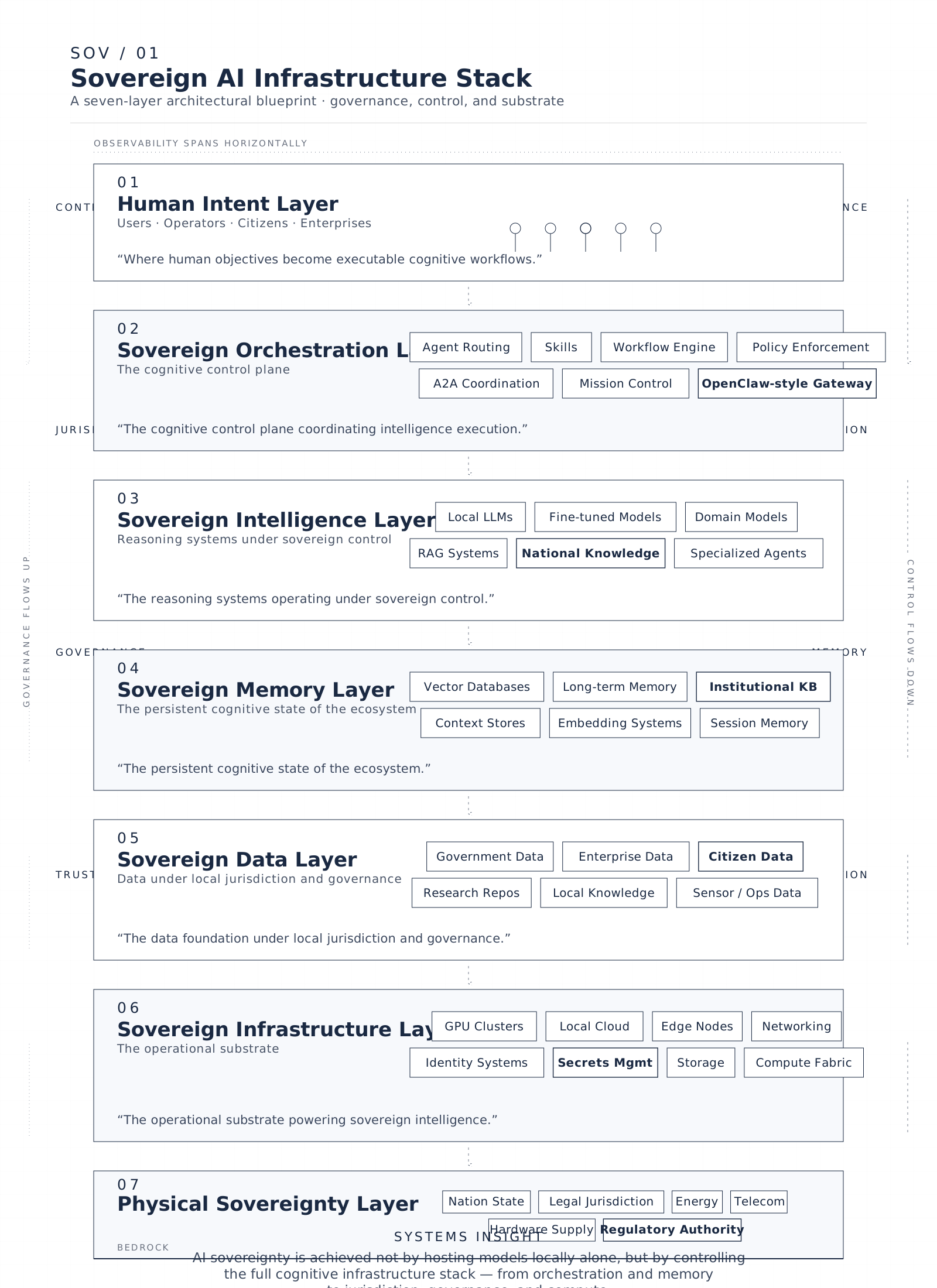
The mature posture is to treat sovereignty as a property of the full stack, from compute through model through orchestration through retrieval through instruction through governance through observation. Any layer not governed inside the institution is a layer through which external authority can shape what the institution's system does.
This does not mean every institution must build everything itself. It means every institution must know which authorities operate inside its systems, must accept those authorities deliberately, and must retain the capacity to govern, replace, or constrain them.
That is the operational definition of sovereignty for AI-native systems. Anything less is dependence with a local-hosting label.
Closing reflection
Sovereignty is an old idea applied to new infrastructure. The instinct to ground it in ownership of physical resources is correct, but incomplete. What has changed is the location of behavior. It no longer lives in the hardware. It lives in the instruction layer, the retrieval layer, the orchestration layer, and the governance authority that binds them.
Institutions that want their AI systems to behave the way they intend must hold authority over those layers. That is the work. It is not glamorous, it is not solved by procurement, and it cannot be acquired by running a model locally. It is a discipline of instruction ownership, governance design, and operational independence — applied with the same seriousness that the previous generation of infrastructure engineers applied to networks, storage, and compute.
The infrastructure conversation has been louder. The behavioral conversation is the one that will matter.
The next essay in this series will examine trust boundaries in multi-agent systems, and how instruction layers either uphold or quietly erode them.