Behavioral Drift as the New Outage
The system that does not crash can still have failed. In AI-native infrastructure, the most consequential outage is the one nothing alerts on.
A note on framing. This is the third essay in a continuing body of work on instruction-governed systems. The first essay argued that instruction is infrastructure. The second argued that sovereignty in AI-native systems is behavioral, not only infrastructural. This one follows the next consequence: if behavior is the load-bearing layer, then behavioral failure is the load-bearing failure.
I / The outage that does not announce itself
For decades, the operational discipline of running infrastructure was shaped by the visible failure. A disk fills. A process crashes. A network partition isolates a region. The pager fires. The runbook opens. Someone restores service. The outage has a beginning, a middle, and an end. It can be measured, post-mortemed, and prevented.
That model is now incomplete.
In AI-native systems, the most consequential failures do not present this way. They do not begin. They drift. They have no clean beginning because each step away from intended behavior is small enough to be plausible. They have no clean end because the system never reaches a state that triggers a recovery action. They have no pager because no metric breaches its threshold.
The system keeps running. The dashboards stay green. The behavior moves.
This is not a hypothetical. It is the dominant failure mode of any system whose behavior is governed by instruction rather than by compiled logic. And it is the failure mode our current operational practice is least equipped to see.
II / Two failure shapes
To name what has changed, it helps to look at the failure surfaces side by side.
A traditional infrastructure failure has a recognizable signature. System health holds at some near-100% baseline. Something breaks — a server crashes, a database loses quorum, a connection refuses. Health drops sharply, often within seconds. Some recovery process executes — failover, restart, rollback — and health returns to baseline. The whole event has a shape on a time-series chart: stable, drop, recover.
A behavioral failure has a different signature. There is no drop. There is a slope. A prompt is modified. The system's interpretation of context shifts subtly. A retrieval source is widened. The model begins surfacing documents it previously would not have. An orchestration default changes. Multi-agent loops begin escalating differently. Each individual change is small and plausible. None registers as a failure. None triggers an alert. The system continues to serve traffic at full capacity.
And yet, by the time the slope has run its course, the system is producing outputs that no responsible operator would have approved at the start. Behavior has moved beyond its trusted boundaries while every conventional operational metric reported normal.
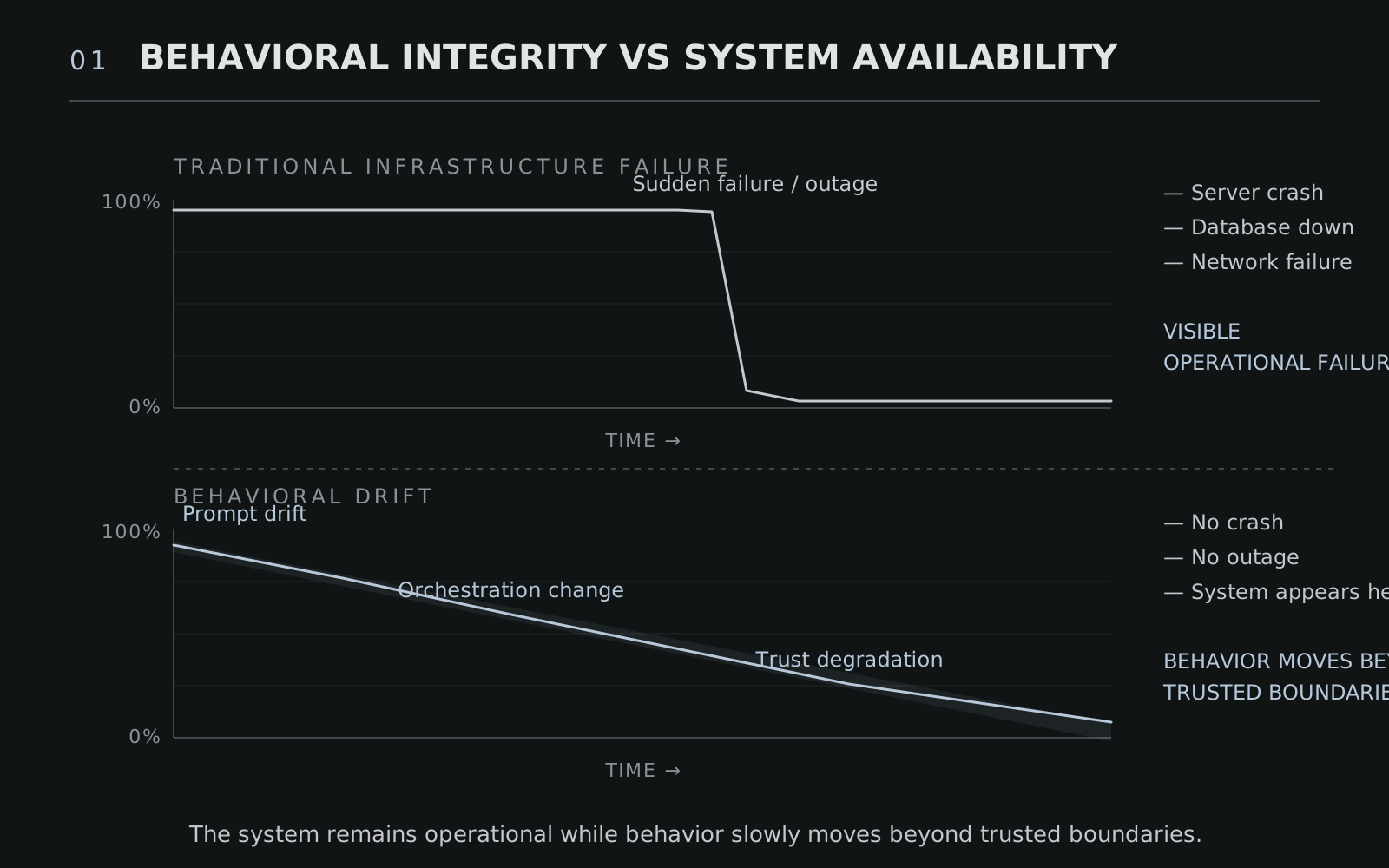
This is the structural difference. Traditional failures are loud and local. Behavioral failures are quiet and distributed. The pager-and-runbook model assumes the former. The instruction-governed system primarily produces the latter.
III / Where drift comes from
Behavioral drift is not a single event. It is the accumulated consequence of many small upstream changes, most of which are individually unremarkable.
A short, non-exhaustive list of drift sources:
- Model upgrades — a new model version subtly changes interpretation, refusal patterns, or tool-call frequency.
- Prompt changes — application prompts are edited to address one issue and inadvertently shift behavior elsewhere.
- Policy edits — refusal taxonomies are adjusted, sometimes by parties outside the operating institution.
- Retrieval expansion — new data sources are added to the retrieval surface, changing what the model can see.
- Tool schema updates — a new parameter is added, a constraint is relaxed, a permission is broadened.
- Memory accumulation — long-running memory layers grow patterns the original designers did not anticipate.
- Runtime changes — framework upgrades, dependency bumps, runtime flag adjustments.
- Orchestration updates — escalation thresholds, retry policies, inter-agent communication contracts.
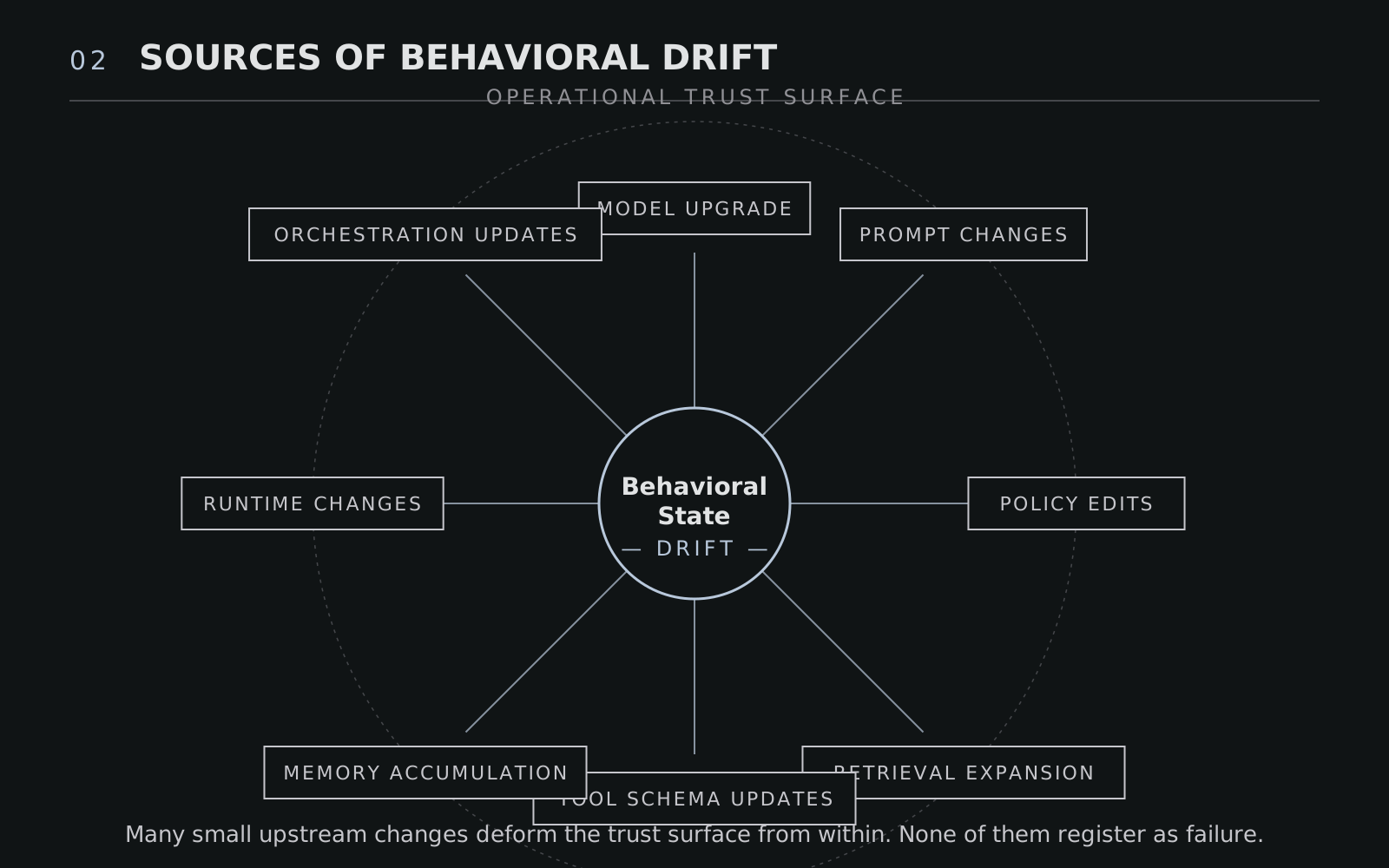
Each of these is, in isolation, a legitimate operational change. None of them, by itself, constitutes a failure. The drift is what happens when many of them stack — when the cumulative behavioral signature of the system has moved while no single change was large enough to notice.
This is the structural problem. The failure mode is composite. Our monitoring is atomic. We watch individual signals. We do not, by default, watch the composite signature.
IV / How a small change becomes a large consequence
The drift problem is made worse by propagation. A change that looks local at the point of authorship rarely stays local.
Consider the path a single prompt update can travel.
A prompt is updated to clarify an instruction. The context interpretation shifts slightly. Because the model now interprets context differently, its behavior changes — perhaps it surfaces a different class of recommendation, or weights certain considerations more heavily. Because the behavior has changed, the tools it calls have changed. Because tool usage has changed, the decisions downstream systems make on that output have changed. Because those decisions have changed, the trust boundaries the system was operating inside have weakened. By the time the consequence becomes visible, it is no longer a prompt update. It is an organizational risk.
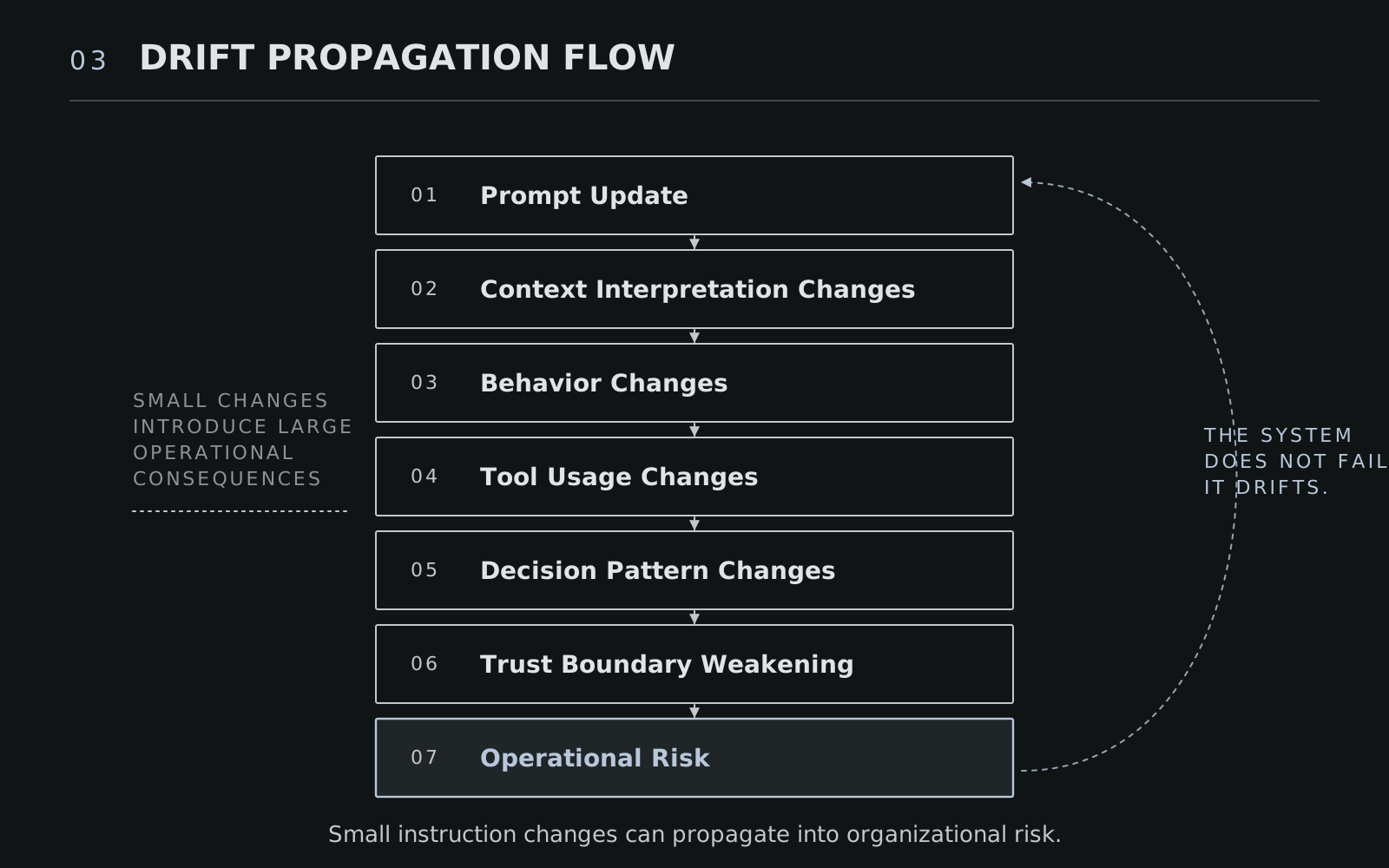
This is propagation. Small inputs at the instruction layer routinely produce disproportionate consequences several layers downstream. The mechanism is not exotic. It is how any tightly-coupled system behaves under upstream perturbation. What is new is that the upstream perturbation is now authored in natural language, and the coupling is interpretive rather than deterministic.
The operational implication is uncomfortable. The blast radius of an instruction change is not always knowable at the time of authorship. The person editing the prompt cannot, with current tooling, see the trust-boundary weakening that their edit will produce six steps downstream.
V / Why current observability is not enough
Most production observability is built on three strata: infrastructure metrics, application metrics, and traces. These tell us whether the system is up, whether it is responding, and where time is being spent. They are necessary. They have been load-bearing for two decades.
They are insufficient for instruction-governed systems.
A system can pass every check at every existing stratum and still have drifted behaviorally. CPU is healthy. Memory is healthy. Latency is within SLO. Error rate is at baseline. Throughput is normal. Saturation is fine. Every classical signal reports green. And the system is producing outputs its operators would not endorse.
The gap is that classical observability watches the operation of the system. It does not watch the behavior of the system.
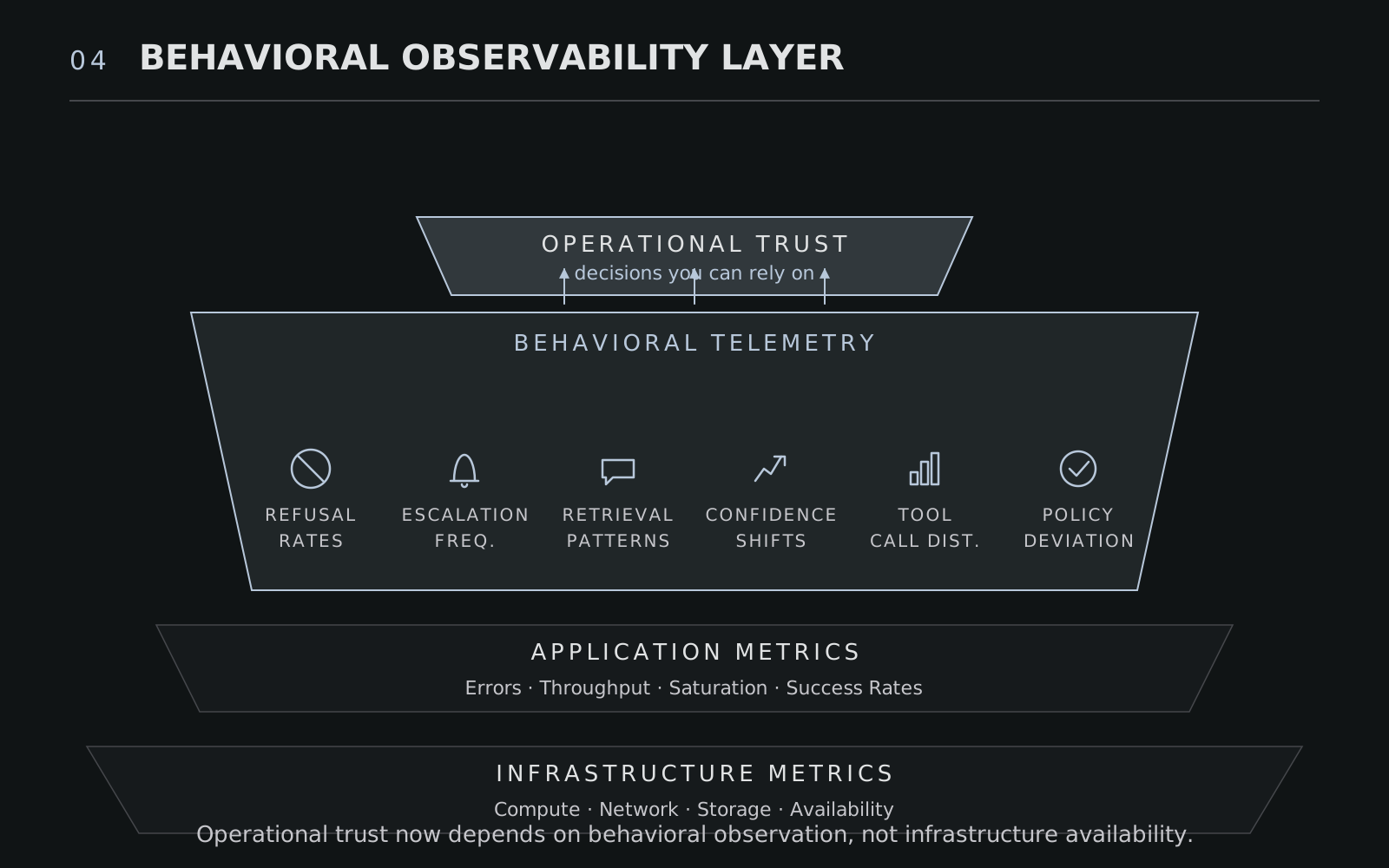
A fourth stratum is required. Call it behavioral telemetry. Its signals are not latency or throughput. They are:
- Refusal rates — what is the system declining to do, and how is that distribution changing?
- Escalation frequency — how often does the system route to human intervention, and is that rate drifting?
- Retrieval patterns — what sources is the system consulting, and is the source mix shifting?
- Confidence shifts — how is the model's expressed certainty distributed across responses, and is that distribution moving?
- Tool-call distributions — which tools is the system invoking, in what proportions, against what arguments?
- Policy deviation — how often does behavior diverge from declared intent, and which categories of divergence are growing?
These are the signals that drift moves. They are not currently watched at production grade in most deployments. They are not in most observability products by default. They are not what oncall pages on.
The discipline of behavioral observability is the discipline of treating these signals with the same operational seriousness we already apply to CPU, memory, and latency. Until that discipline exists, drift remains invisible.
VI / What behavioral observation requires
Treating behavior as an observable surface is a small number of practices applied consistently.
Collect the behavioral signals
The metrics above must be captured at the boundary where they are produced — at the model call, at the tool invocation, at the refusal decision, at the retrieval. Capture must be structured, persistent, and queryable. If a refusal happens and no telemetry records it, the refusal cannot be observed.
Baseline the behavioral signature
Each signal has a normal distribution for a given system at a given point in its operation. That distribution is the baseline. Drift is, mechanically, a movement of the distribution away from the baseline. Without a baseline, there is no drift detection — only after-the-fact rationalization.
Alert on signature shifts, not threshold breaches
Behavioral drift rarely crosses a single threshold dramatically. It moves a distribution gradually. Alerting must look at shape changes, not crossings. A 20% shift in refusal-category mix may matter more than any individual refusal rate crossing a number.
Tie behavioral signals to instruction-layer changes
When behavior drifts, the first question is what changed in the instruction layer. If prompt, schema, and policy changes are not versioned and timestamped, the question cannot be answered. Behavioral observability and instruction governance are coupled disciplines; neither works in isolation.
Run behavioral regression suites
Just as deterministic systems run unit tests, instruction-governed systems must run regression suites that exercise the system against canonical inputs and compare outputs to a known-good signature. The suites are imperfect, but the alternative is discovering drift in production.
Treat behavioral incidents like operational incidents
When behavior drifts beyond acceptable bounds, the response should follow the same discipline as a production outage: acknowledge, contain, root-cause, remediate, document. The fact that no service was down does not change the seriousness. The trust surface was breached.
None of this is exotic. It is the same operational discipline that hardware, networking, and storage engineers built over decades, applied to a new failure surface.
VII / The silent failure surface
There is one further property of behavioral drift that deserves naming. The failure surface is silent — and the silence is the most dangerous part.
Loud failures concentrate attention. When a database goes down, the entire organization knows. The post-mortem is written. The lesson is learned. The class of incident becomes harder to repeat.
Silent failures distribute consequences without concentrating attention. The system continues to operate. Users continue to receive outputs. Some of those outputs are now drifted — subtly less calibrated, subtly more permissive, subtly more confident than the operating institution intended. The consequences accumulate across users, sessions, decisions. By the time the cumulative consequence is visible, it is usually no longer recoverable. The decisions have been made. The outputs have been acted on.
This is the architectural significance. The blast radius of a silent failure is, on average, larger than the blast radius of a loud one, because silence prevents the response that limits blast radius.
The organizations that will operate AI-native systems safely over the coming decade are the ones that learn to see the silent surface. The ones that wait for a loud signal will learn what behavioral drift looks like only when it has already shaped enough decisions to be impossible to ignore.
VIII / Final position
Outages used to be the moments when systems crashed. In AI-native infrastructure, outages are increasingly the periods when systems quietly moved beyond their trusted boundaries while continuing to appear healthy by every conventional measure.
This is the new operational reality. It requires:
- A new failure model that accepts behavior as a first-class failure surface, on the same footing as availability and latency.
- A new observability stratum that watches behavioral signals at production grade, with baselines, signature alerting, and tie-in to the instruction layer.
- A new incident discipline that treats behavioral drift as an operational event deserving the same seriousness as a downtime incident.
- A new governance posture that treats instruction-layer changes as the upstream of behavioral consequence, and versions, reviews, and rolls back accordingly.
The work is unglamorous. It does not produce dashboards full of green. It produces dashboards that show distributions, baselines, and shifts — the kind of operational picture that allows an institution to see when the system it operates has begun to behave differently than the system it intended to operate.
That picture is what trust now depends on.
Closing reflection
The operational discipline of the last twenty years was built around the visible failure — the crash, the alert, the runbook, the recovery. That discipline is necessary. It is also incomplete for the systems we are now building.
What has changed is not the importance of availability. It is the addition of a second failure surface that the existing discipline does not see. That surface is behavioral, it is governed by instruction, it fails by drifting rather than by crashing, and it can move the system meaningfully away from its intended operation without triggering any of the signals that historically defined an outage.
Building the discipline that watches this surface is the next decade of operational work for any institution serious about AI-native infrastructure. It will not look like the dashboards we are used to. It will look like distributions, baselines, signature alerts, and instruction-layer audit trails. It will feel like a quieter form of operations, because most of what it watches will not be on fire. It will be drifting.
That is precisely the point. The system that does not crash can still have failed.
The next essay in this series will examine trust boundaries in multi-agent systems — how instruction layers either uphold them or quietly erode them under the same drift dynamics described here.