Instruction as Infrastructure
The instructions we give to systems are no longer commands — they are infrastructure. They shape behavior, distribute trust, and constrain the future.
A note on framing. This is the opening essay of a longer body of work concerned with how we design, secure, and govern the systems we are now building — systems that increasingly think, act, and interpret on our behalf.
I / The quiet relocation
For most of the history of computing, instructions lived on the surface. A function was called. A button was clicked. A query was issued. The substrate beneath — kernels, networks, storage, schedulers — was the infrastructure. Instructions sat above it, ephemeral, transactional, easily replaced.
That relationship has quietly inverted.
Modern systems are now governed less by their compiled logic than by the instructions they receive at runtime. A multi-agent platform behaves the way its system prompts behave. A retrieval pipeline behaves the way its policies allow. An autonomous workflow behaves the way its tool schemas permit. The instructions are no longer instructions. They are the architecture.
This shift is easy to miss because it happens in plain language. A YAML file. A markdown prompt. A few lines of natural-language policy. They look like configuration. They behave like infrastructure.
II / What we mean by instruction
Instruction, in this essay, is not a single artifact. It is a layered construct that includes:
- System prompts and persona definitions
- Tool schemas, permissions, and call constraints
- Retrieval policies and data-access boundaries
- Governance rules, escalation thresholds, and refusal criteria
- Operational contracts: SLAs, budgets, idempotency keys, audit hooks
- Behavioral defaults encoded in agents, orchestrators, and guardrails
Each of these used to be implementation detail. Together, they are now the load-bearing structure of any serious AI-native system. They determine how the system perceives the world, what it is allowed to do in that world, and what it must refuse.
In classical infrastructure terms, this is the new control plane.
III / Why this is a relocation, not an addition
It is tempting to describe instructions as a new layer added on top of existing infrastructure. That framing is comfortable but inaccurate. What has actually happened is structural: behavior has migrated out of code and into instruction.
Consider a familiar contrast.
In a deterministic system, behavior is encoded. The code is the contract. Reading the code tells you what the system will do. In an instruction-governed system, behavior is negotiated at runtime between a model, a set of tools, a set of policies, and a context window. The code tells you what the system can do. The instruction tells you what it will do.
The center of gravity has moved. The places we used to look for behavior — the function body, the service boundary, the API contract — now hold only the mechanics. The intent lives in the instruction layer.
That is what makes instruction infrastructural. Not its prominence, but its load-bearing role.
IV / The properties of infrastructure
Infrastructure is recognized by a small set of properties. It is persistent. It is shared. It is consequential when it fails. It must be observed. It must be governed. It cannot be changed casually.
Apply the test honestly to a modern multi-agent platform.
Are its prompts persistent across sessions? Yes — through memory, journals, and continuity layers. Are they shared across agents and tenants? Often, yes — through inherited system prompts and policy bundles. Are they consequential when they fail? Acutely so — a single overly permissive instruction can leak data across tenants, authorize destructive tool calls, or quietly degrade the trustworthiness of every downstream output. Must they be observed? Yes — through tracing, evals, and red-team probes. Must they be governed? Increasingly, yes — through versioning, approval flows, and signed scope documents.
By every operational test, instruction is infrastructure.
The fact that it looks like prose is irrelevant to its architectural role.
V / The failure modes are different — and quieter
Traditional infrastructure failures announce themselves. A disk fills. A process crashes. A connection refuses. The signal is loud and the locus is clear.
Instruction failures are quieter. They do not crash. They drift.
A prompt that once produced calibrated outputs slowly begins to overreach, because the underlying model was upgraded and the instruction was not re-tuned. A policy that once excluded sensitive data begins to include it, because a retrieval source was widened upstream. A tool schema that once restricted side effects begins permitting them, because a new field was added without revisiting the contract.
None of these triggers an alert. All of them change what the system is.
This is the architectural significance of instruction. Its failure surface is behavioral, not operational. The system keeps running. It simply stops behaving the way you assumed it did. By the time the gap is visible, it is usually distributed across many users, many sessions, and many decisions.
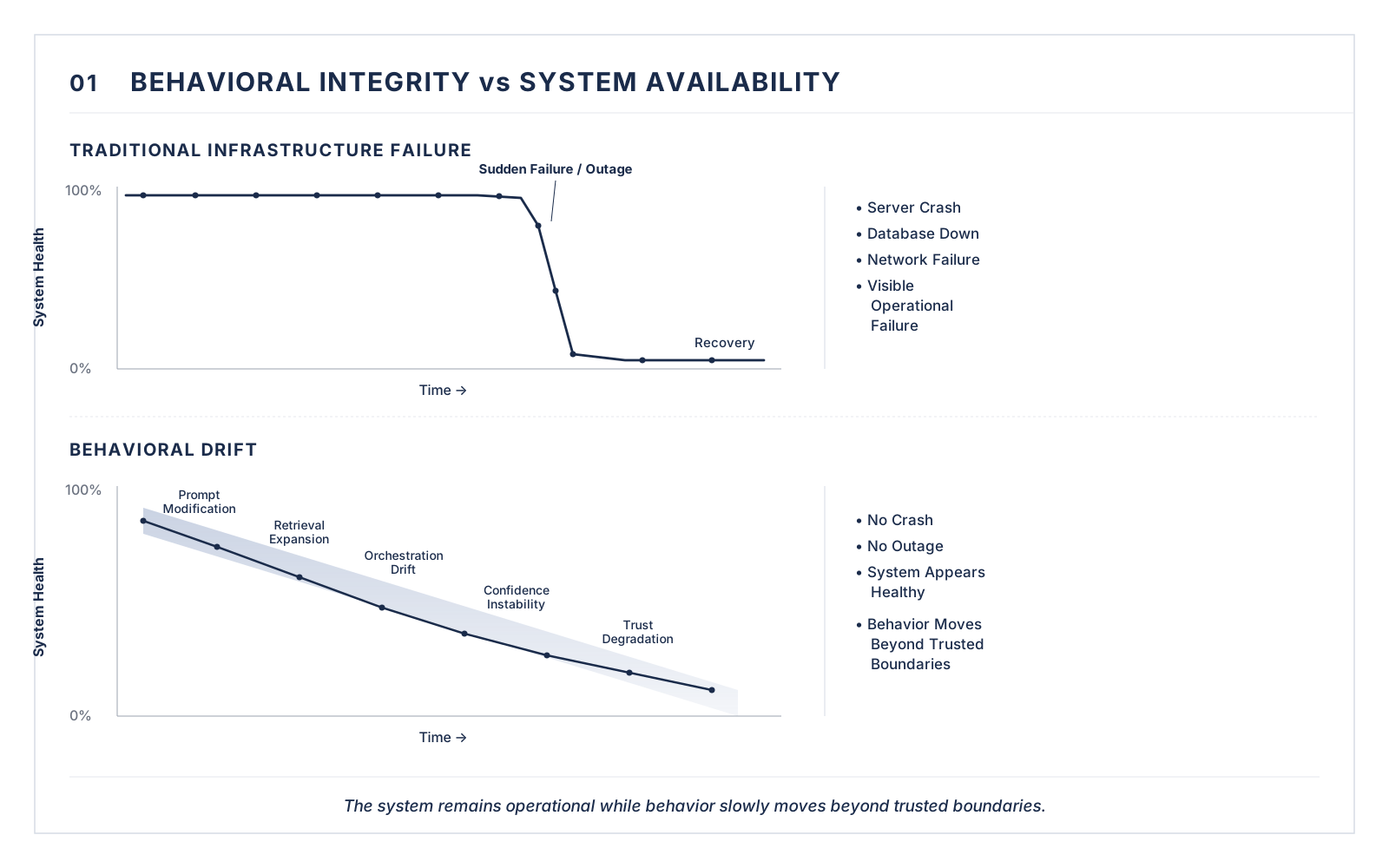
Treating instruction as infrastructure means accepting that its failure modes deserve the same engineering seriousness as a database outage. They are harder to detect, slower to surface, and more expensive to reverse.
VI / Instruction as a trust boundary
Every infrastructure layer is also a trust boundary. Networks separate internal from external. Storage separates accessible from privileged. Compute separates isolated from shared.
Instruction is now doing the same work, but along behavioral lines.
A system prompt is the boundary between what an agent will and will not attempt. A tool schema is the boundary between what an action can and cannot touch. A retrieval policy is the boundary between what a model can and cannot see. A refusal criterion is the boundary between what a system will and will not produce.
The implication is structural. If instruction is a trust boundary, then instruction must be treated with the same discipline we apply to any other boundary: signed, versioned, audited, monitored, and minimally permissive by default.
We have not yet built this discipline at scale. Most production AI systems today treat instruction the way early web systems treated configuration — as ambient text owned by whoever happened to be editing it last. That posture will not survive contact with autonomous systems operating across tenants, regions, and regulatory regimes.
VII / The governance consequence
Once we accept that instruction is infrastructure, the governance question re-shapes itself.
Governance ceases to be a question of what the system is allowed to do. It becomes a question of what the system is allowed to be told.
This is a substantial reframing. It moves governance upstream of execution. It places the decision boundary at the point where intent is encoded, not at the point where action is taken. It treats prompt changes the way we treat schema migrations — as consequential events with blast radius, rollback plans, and approval surfaces.
For organizations with serious obligations — regulated industries, public infrastructure, national systems — this is not optional. The governance surface of an AI-native system is its instruction surface. Whoever can modify the instructions can modify the system, regardless of who owns the code.
This is the part that compliance frameworks have not yet fully absorbed. ISO 27001, SOC 2, and HIPAA were written for systems where instruction was peripheral. They will need to grow into a world where instruction is the control plane.
VIII / Designing for an instruction-governed world
If instruction is infrastructure, then it deserves infrastructure-grade practice. A short, working list:
Versioning
Every prompt, policy, and schema should be semver-tagged and reproducible. There should be no "live edit" of a production instruction without an audit record.
Layered authorship
The people who write system prompts, the people who write tool schemas, and the people who approve them should not all be the same person. Separation of duty is a control, not a ceremony.
Pre-flight validation
Instructions should be evaluated before they are deployed, against a regression suite of expected behaviors. Behavior, not syntax, is what changes.
Behavioral observability
Telemetry should capture not only latency and cost, but the behavioral signatures of the system — refusal rates, tool-call distributions, retrieval-source frequencies, output category mixes. Drift in these signatures is the early warning that instruction has shifted.
Blast-radius awareness
Some instructions are local. Others propagate. A change to a shared system prompt or a global policy bundle has the same blast radius as a change to a shared database schema and should be treated the same way.
Minimum-viable permission
Tool schemas should whitelist, never blacklist. Retrieval policies should default to exclusion. Refusal should be the inexpensive path.
Rollback as a first-class operation
The ability to revert an instruction change quickly, completely, and safely is no less critical than the ability to revert a deployment.
None of this is exotic. It is the same engineering discipline that hardware, networking, and storage engineers built over decades. The novelty is only in its application to a layer that looks like prose.
IX / The philosophical undercurrent
There is a quieter point underneath the operational one.
When instructions become infrastructure, the act of writing them becomes an act of architecture. The phrasing of a system prompt determines the disposition of a system. The structure of a policy determines what is thinkable inside that system. The choice of refusal criteria determines what the system declines to become.
This is not a small thing. It is the closest engineering has come to governance-by-language. The words we write into the instruction layer become the conditions under which decisions are made, at scale, on behalf of people who will never read those words.
That responsibility deserves to be named. It is not enough to write instructions that work. They must be written with the awareness that they are now part of the operational fabric of the system, and through it, part of the operational fabric of the institutions that depend on the system.
X / Closing position
The systems we are building now are governed by instruction in a way the systems we built before were not. That fact is structural, not cosmetic. It deserves to be treated as such.
Instruction is no longer a surface. It is a substrate. It carries load. It defines boundaries. It fails quietly. It propagates widely. It governs what the system is, more reliably than the code does.
The mature response is not to write more instructions. It is to treat the instruction layer as infrastructure: versioned, observed, governed, constrained, and respected.
The rest of this publication will sit on top of that premise.
An instruction-governed system is only as trustworthy as its instruction layer is observable, versioned, and bounded. Without that discipline, the system's behavior is not engineered — it is inherited from whoever wrote the last prompt.
- Instructions are load-bearing — Treat their lifecycle with the seriousness of schema changes, not configuration tweaks.
- Behavioral drift is the new outage — Observe behavior, not only performance. The system that does not crash can still have failed.
- Governance moves upstream — The decisive control point is where instructions are authored and approved, not where actions are executed.
A note on what comes next
Subsequent essays in this series will examine specific consequences of this relocation:
- Sovereign AI infrastructure and the question of where instructions may legitimately originate.
- Trust boundaries in multi-agent systems, and how instruction layers either uphold or quietly erode them.
- Observation as an active state — the operational practice of watching behavioral surfaces rather than performance surfaces.
- Cybersecurity as behavioral architecture, in a world where the most dangerous misconfigurations are written in natural language.
Each takes the premise of this essay — that instruction is infrastructure — and follows one of its consequences into operational territory.